

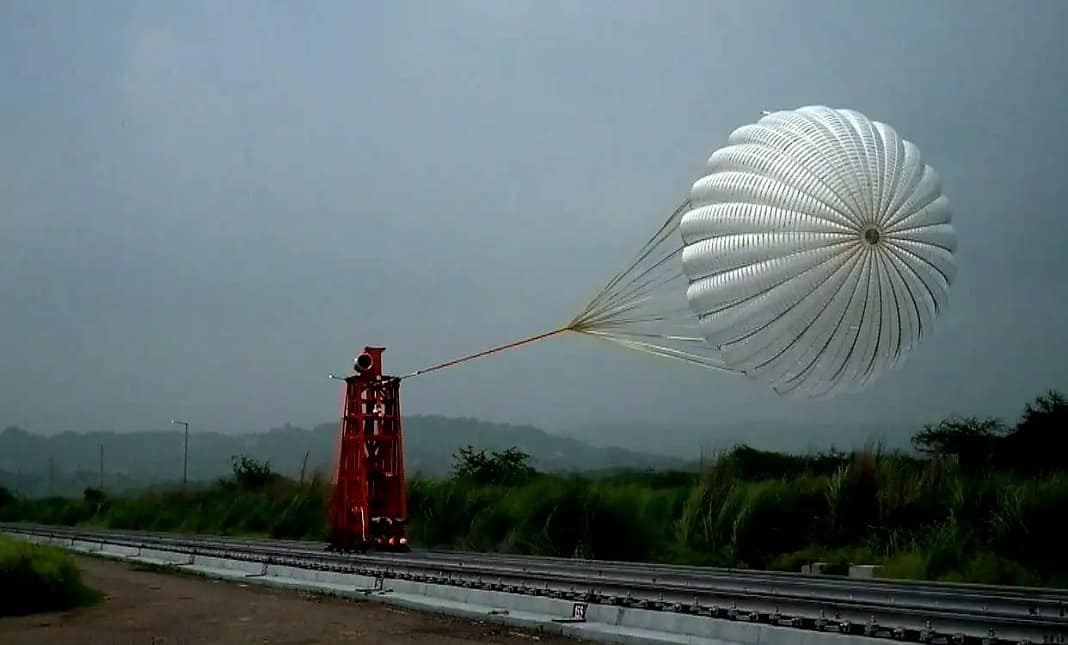

The Defence Research and Development Organisation (DRDO) has successfully completed the qualification-level load test of the Gaganyaan mission’s drogue parachute at its advanced Rail Track Rocket Sled facility in Chandigarh. The high-speed evaluation was conducted at the Terminal Ballistics Research Laboratory (TBRL), home to one of India’s most sophisticated ground-based dynamic testing systems.
The Rail Track Rocket Sled (RTRS) facility is regarded as one of the country’s most advanced platforms for high-speed aerodynamic and ballistic assessments. It plays a crucial role in validating systems designed for both defence and space missions, enabling precise simulation of extreme operational conditions.
The drogue parachute is a critical component of India’s human spaceflight programme, Gaganyaan. During the crew module’s re-entry and descent phase, the drogue parachute deploys first, stabilising the module and significantly reducing its speed before the main parachutes are released. This staged deceleration is vital to ensuring a controlled and safe landing, directly impacting astronaut safety.
In the recent qualification test, the parachute was exposed to loads exceeding the maximum stress levels anticipated during actual flight. By subjecting the system to forces beyond operational limits, engineers were able to validate an additional safety margin in its structural design, reinforcing confidence in its reliability under extreme conditions.
The trial was carried out in collaboration with the Vikram Sarabhai Space Centre (VSSC) under the Indian Space Research Organisation (ISRO), along with DRDO’s Aerial Delivery Research and Development Establishment (ADRDE). Officials said the successful qualification highlights India’s growing expertise in designing and manufacturing high-strength ribbon parachutes tailored for complex aerospace applications.
Defence Minister Rajnath Singh congratulated DRDO, ISRO, and associated industry partners on the achievement, calling it a significant step toward strengthening the vision of Atmanirbhar Bharat in critical space technologies.