

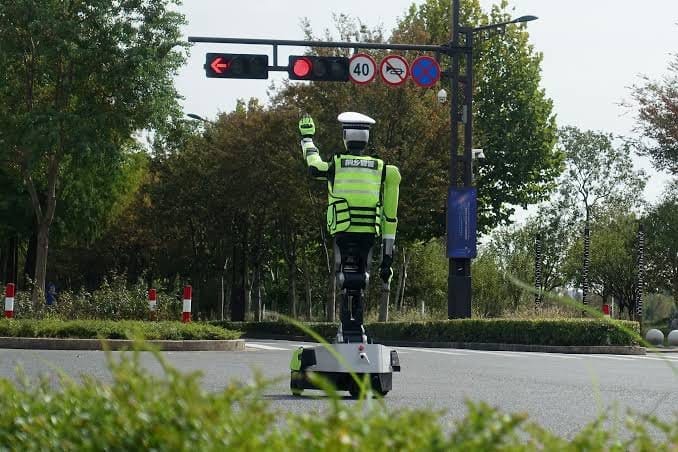

Hangzhou, China, has begun testing its first AI traffic robot, Hangxing-1, at a busy junction in the Binjiang district. The robot uses hand signals to guide both cars and pedestrians, working alongside traffic lights while monitoring unsafe actions in real time with cameras and sensors.
Reports indicate that Hangxing-1 can issue spoken warnings if someone crosses at the wrong time or rides an e-bike without a helmet. It reacts immediately when a person steps over the line or stops in a risky spot. Locals have praised the robot, with one motorcyclist saying it encourages people to stop at the waiting line, helping save police manpower.
Police explained that the robot has two modes: one places it in the road center to signal drivers, while the other keeps it near traffic lights to manage flow. Built locally, Hangxing-1 combines motion control, visual checks, and a voice system to handle routine tasks typically managed by officers.
The city hopes the robot will reduce pressure on human officers during peak hours and provide faster responses to changing traffic conditions or crowd events. Officials also said the system could improve as it operates in more real-world scenarios.
Hangzhou plans to continue testing Hangxing-1 at other crossings, and if successful, more units may be deployed. Authorities emphasized that the robot is intended to support, not replace, human officers, aiming to make crossings safer and reduce minor violations.